
6 or 12 per cent VAT? A checklist for restaurants and takeaway

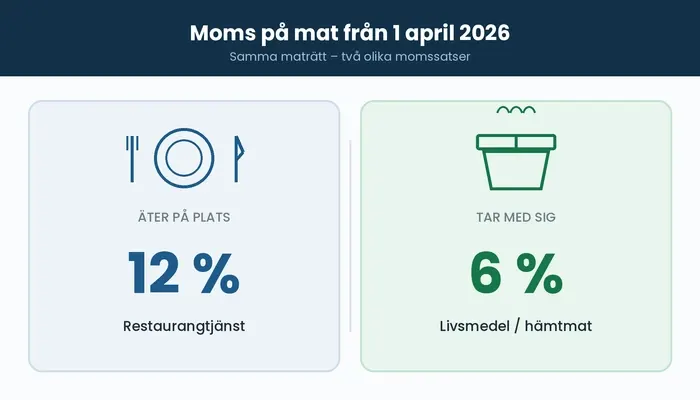
Since 1 April 2026, VAT on food has been 6 per cent instead of 12. If you run a restaurant, café or street food outlet, this means the same dish can have two different VAT rates depending on how it is sold: 6 per cent if the customer takes the food away, 12 per cent if the customer eats on the premises.
It sounds simple in theory. In practice, this is currently the most common source of errors at the till and in the VAT return. This guide explains where the line is drawn, which borderline cases you need to keep an eye on and what you actually need to do in your till system and bookkeeping.
What changed on 1 April 2026?
The VAT rate on food was cut from 12 to 6 per cent on 1 April 2026, and the reduction applies up to and including 31 December 2027. It is a temporary measure intended to soften the impact of high food prices.
VAT on restaurant and catering services remains at 12 per cent. That is the whole point of the dividing line that has now appeared: for a restaurant where customers can choose between eating in or taking the food home, VAT is 12 per cent in the first case and 6 per cent for the takeaway.
In other words, it is not what you sell that determines the VAT rate, but how you sell it.
The difference between food and a restaurant service
The basic principle is that a restaurant service includes an element of service on top of the food itself: premises to sit in, table setting, serving, staff who clear the tables. Without those elements, it is simply a sale of food.
When does 6 per cent apply?
Six per cent applies when the customer buys the food and takes it out of the premises:
- Takeaway from a restaurant, pizzeria or street food outlet
- Food delivered to the home via an app, for example Foodora or Uber Eats
- Food from a food truck or food cart that the customer collects and takes away
- Coffee, soft drinks, juice and other drinks that count as food
- Pastries, sandwiches and salads sold over the counter in the café
When does 12 per cent apply?
Twelve per cent applies when the sale is a catering service:
- Food and drink that the customer eats at a table in the restaurant
- Lunch buffets and à la carte with table service
- Catering where you are on site with staff, table setting and waiting service
- Room service in hotels
Note that alcoholic drinks still carry 25 per cent VAT, whether they are served on the premises or sold for takeaway. The reduced VAT on food does not affect alcohol.
The borderline cases that are hardest to assess
It is in the grey zone that mistakes happen. Some situations that regularly raise questions:
- The café with a couple of tables.
If the business only has the odd table along the wall, the starting point is that it is a sale of food, but a well-kept outdoor seating area that the staff look after may instead be assessed as a restaurant service. It is the overall impression of the business that decides. - The customer stands at a bar counter.
Purchases in the restaurant where the food is eaten at a counter without service are a genuine borderline case that may need to be assessed individually. - Catering without staff.
If you only deliver ready-made food, without serving on site, it may count as a sale of food at 6 per cent. If you are on site and handle the serving, it is 12 per cent. - Hotel breakfast and room service.
The fact that guests fetch the food themselves does not automatically mean 6 per cent applies, if the premises and the set-up are otherwise a dining environment.
Example: the same dish, two VAT rates
Say the lunch costs SEK 145 including VAT.
| Eat in | Take away | |
|---|---|---|
| VAT rate | 12% | 6% |
| VAT | SEK 15.54 | SEK 8.21 |
| Net to the company | SEK 129.46 | SEK 136.79 |
If you keep the same price for the customer, each takeaway lunch brings in just over SEK 7 more net. If you would rather pass the reduction on to the customer, the same net income can be achieved at a price of around SEK 137.
This is a pricing decision, not a bookkeeping decision, but it is worth making deliberately rather than letting the till system make it for you. Feel free to use our advisory services if you are thinking about changing your pricing.
Checklist: till system and bookkeeping
The item register in the till
- Set up separate items, or a clear toggle function, for “eat in” and “take away”
- Check that each item is linked to the correct VAT rate: 6, 12 or 25 per cent
- Make sure staff know how the choice is recorded, especially during the lunch rush
- Test a few receipts for real and check that the VAT comes out right
Bookkeeping and VAT return
- Check that the correct VAT account is linked to each type of sale, otherwise the amounts will end up wrong in the VAT return
- Keep takeaway and table service separate in the bookkeeping so that the records can be followed afterwards
- Remember that the date of supply determines the VAT rate, not the invoice date
- Reconcile the first VAT period with extra care after every change
Purchases, entertainment and price lists
- Review input VAT on purchases of food from suppliers, dairies and wholesalers
- Check how VAT deductions for business entertainment are calculated when the purchase includes food
- Update menus, price lists and ordering pages so that they match the till
- Inform your staff: most errors happen at the till, not in the accounting
When does a sale need a closer look?
Take a second look if any of the following applies to your business:
- You sell both takeaway and table service on the same premises
- You have seating but no real table service
- You combine a shop and a café, for example a farm shop or bakery
- You deliver food to businesses and events with varying set-ups
- You only have outdoor seating for part of the year
In unclear cases you can apply for an advance ruling (förhandsbesked), but in most situations it is enough to go through the business's different sales flows thoroughly once and document your assessment.
What happens after 31 December 2027?
The reduction is temporary. When it ends, VAT on food returns to 12 per cent, and till systems, item registers and price lists will need to be changed again. Set a reminder now, and ideally build your set-up so that a VAT change can be made without having to redo the entire item register.
Source:News item from the Swedish Tax Agency (Skatteverket) on the reduced VAT on food, published 26 February 2026. The change has applied since 1 April 2026.
Do you need help with your VAT?
Unsure how the dividing line should be handled in your particular business?
We go through your sales flows, help you set up your till system and bookkeeping correctly and make sure your VAT return is right from the first period.
At Ekonomico we handle ongoing accounting at a fixed price for restaurants, cafés and businesses that sell food. Book a call and we will look at your set-up.
Get a price proposal for your company
Tell us what you need help with and we will come back with a proposal tailored to your needs.
- Free first meeting
- A fixed price before you decide
- No lock-in period
Call us on 031 - 52 40 00, weekdays 09:00 - 17:00. Or fill in the form and we will get back to you within 24 hours on weekdays.